Selecting The Right Wood for Your Deck, Fence, Gate or Arbor
To ensure you are delighted with your custom made arbor, fence, gate or deck -- you want to choose the right wood for your arbor, deck, fence or gate. In Los Angeles, the popular woods used for exterior projects vary in terms of cost and quality, as well as their ability to resist the elements (water, sun and pests), provide visual appeal in color and appearance and be maintained.
You will need to select wood for two purposes ... the framing or the substructure used to support the weight of the structure ... and the wood used for fencing, decking or trim.
Wood For Framing & Substructures
The first type of wood to choose is the wood to be used for your substructure or hidden framing.
- Pressure Treated Wood ~ For hidden framing, I only use pressure treated lumber. This wood is treated with a variety of chemicals to make it resistant to termites and rot. In the last year, a major change has been made to the preservatives used -- they are safer for the environment but less effective.
- Redwood ~ For visible framing, such as gate and fence posts and cross pieces, you can upgrade to redwood for a better appearance.
Wood For Decking, Fencing & Arbors
There are different woods available depending on the type of project you are interested in.
Wood Choices For Fences & Gates
There are several popular choices for fence boards. Once you have chosen the boards, I pick the appropriate wood for your trim and posts. Based on your needs and budget, I can also build fences out of other woods and some composite materials.
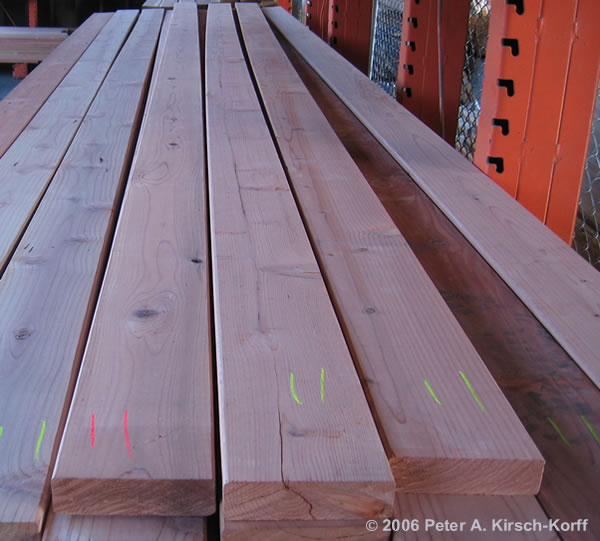
- Cedar ~ A soft, golden-tan wood (see photo) that offers good weather and termite resistance.
- Redwood ~ A distinctive pink/red colored wood which ages to gray. The red heartwood is naturally resistant to damage from termites and moisture. Any white part of a redwood board, known as sapwood, has little resistance to termites and rot. I use Construction Grade Heart Redwood, commonly known as Con Heart, which has no sapwood and some knots. For trim, I hand select the best clear redwood with the least amount of sapwood possible. I can also use more expensive grades of redwood, if your budget permits.
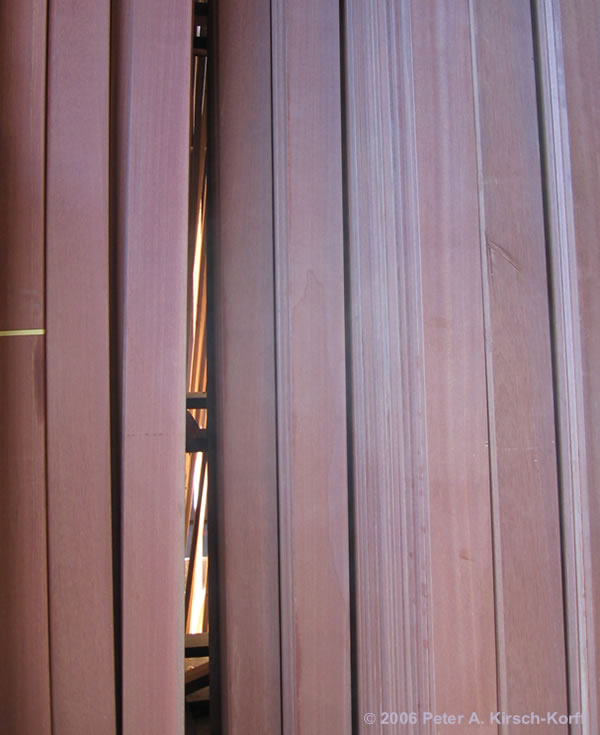
- Mangaris™ (Red Balau) ~ A dense grained, reddish-brown hardwood (see photo) from Indonesia/Thailand that ages to a silver gray like Teak. It stains up like Mahogany and is more durable than Redwood. See the rich color of the unstained wood.
- "Ironwoods" ~ A chocolate brown family of heavy and durable South American hardwoods, including Ipe and Pau Lope. They offer excellent termite and weather resistance. However, they are somewhat more labor intensive and costly.
Wood Choices For Decks
There are several popular choices for deck boards. Once you have chosen the boards, I pick the appropriate wood for your trim, posts and railings. Based on your needs and budget, I can build decks out of other woods and composite materials.
- Redwood ~ A distinctive pink/red colored wood which ages to gray. The red heartwood is naturally resistant to damage from termites and moisture. Any white part of a redwood board, known as sapwood, has little resistance to termites and rot. I use Construction Grade Heart Redwood, commonly known as Con Heart, which has no sapwood and some knots. I can also use more expensive grades of redwood, if your budget permits.
- Mangaris™ (Red Balau) ~ A dense grained, reddish-brown hardwood from Indonesia/Thailand that ages to a silver gray like Teak. It stains up like Mahogany and is more durable than Redwood. It costs about 10-20% more than redwood and is moderately more labor intensive. See the rich color of the unstained wood.
- "Ironwoods" ~ A chocolate brown family of heavy and durable South American hardwoods, including Ipe and Pau Lope. They offer excellent termite and weather resistance. However, they are considerably more labor intensive and it costs about 10-20% more than redwood.
- Composites ~ The best known of these new decking materials is Trex™, an extremely durable mix of wood fibers (sawdust) and recycled plastics. It requires no staining, painting, waterproofing, or regular wood maintenance. However, urban legend has it that squirrels love using Trex edges to sharpen their teeth. New composites are coming on the market every day and research on the Internet will yield lots of options. To see what colors and grains are available, check out Trex's Brasilia,
Accents and Origins products.
Wood Choices For Arbors, Pergolas, Patio Covers and Tree Houses
There are two choices for these larger structures. Based on your needs and budget, I can also build tree houses out of other woods.
- Redwood ~ A distinctive pink/red colored wood which ages to gray. The red heartwood is naturally resistant to damage from termites and moisture. Any white part of a redwood board, known as sapwood, has little resistance to termites and rot. I use Construction Grade Heart Redwood, commonly known as Con Heart, which has no sapwood and some knots. For a beautiful and durable structure, this is your most cost effective choice. I can also use more expensive grades of redwood, if your budget permits.
- Mangaris™ (Red Balau) ~ A dense grained, reddish-brown hardwood from Indonesia/Thailand that ages to a silver gray like Teak. It stains up like Mahogany and is more durable than Redwood. For a high end structure of exceptional durability and striking looks, consider Mangaris. See the rich color of the unstained wood.
Photos of Popular Wood Choices
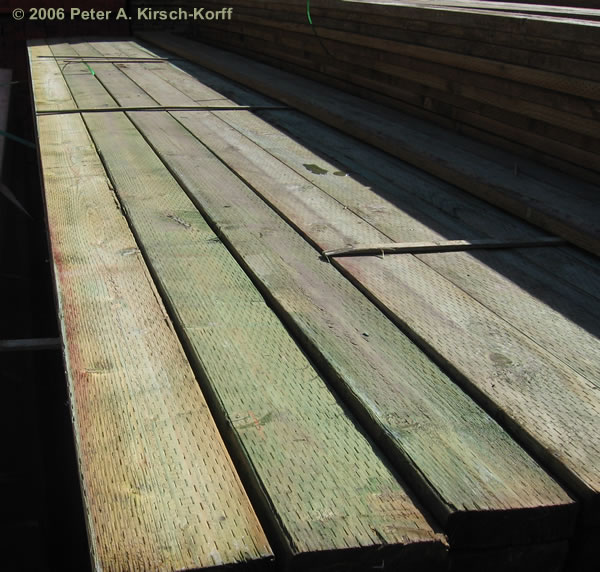
Pressure Treated Lumber
These 2 x 6's are used in framing. The distinctive perforation pattern helps the preservative penetrate deeply into the wood. |
 |
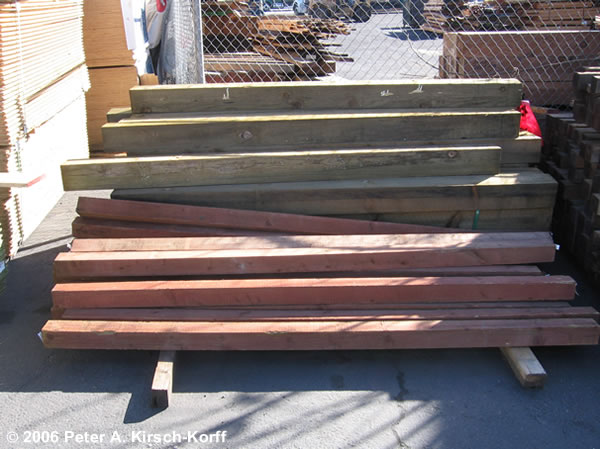
Pressure Treated Wood Posts
These 4 x 4 and 6 x 6 posts are used for framing. |
 |
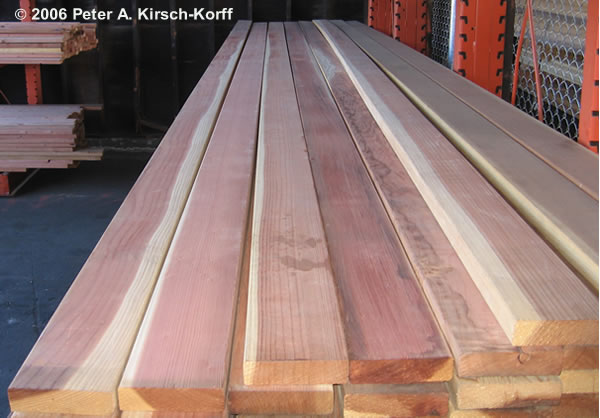
Clear Redwood
Grade that is "clear" of knots but does contain sapwood thus offering excellent appearance but impaired longevity. I use it only for decorative trim after hand selecting boards with the least amount of sapwood. |
 |
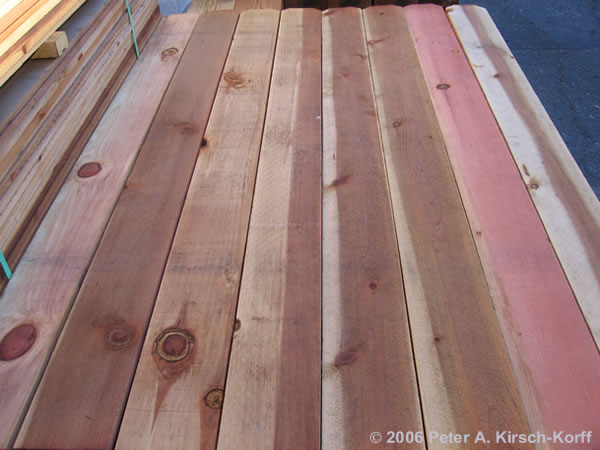
Construction Common Redwood
This lowest grade of redwood fencing has too much sapwood to be used for a high quality fence. |
|
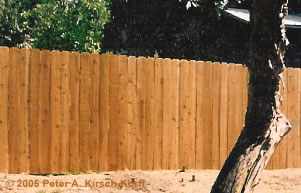
Cedar Fence Boards
These are the standard dog eared fence boards which I use in many of my designs. |
 |
Mangaris ™ (Red Balau)
This fine grained, clear hardwood makes for beautiful garden architecture, especially decks. This timber comes from managed forests in Indonesia and Thailand and combines some of the best attributes of Mahogany and Teak -- and helps support the economic development of the third world. |
 |
Note: Mangaris is a registered trademark. Trex Wood Polymer is a trademark of Trex Company, L.L.C. All other trademarks are the property of their respective owners.
Permission is granted to anyone who wants to
use my work for inspiration outside of the LA area.
|